Local SEO
Limo SEO Basics: How a Small Limo Company Gets Found on Google
A plain-English SEO guide for limo companies: search intent, service, airport and city pages, titles, local schema, reviews, speed, blog topics, local links and measuring results.
EazyLimo Team 7 min read
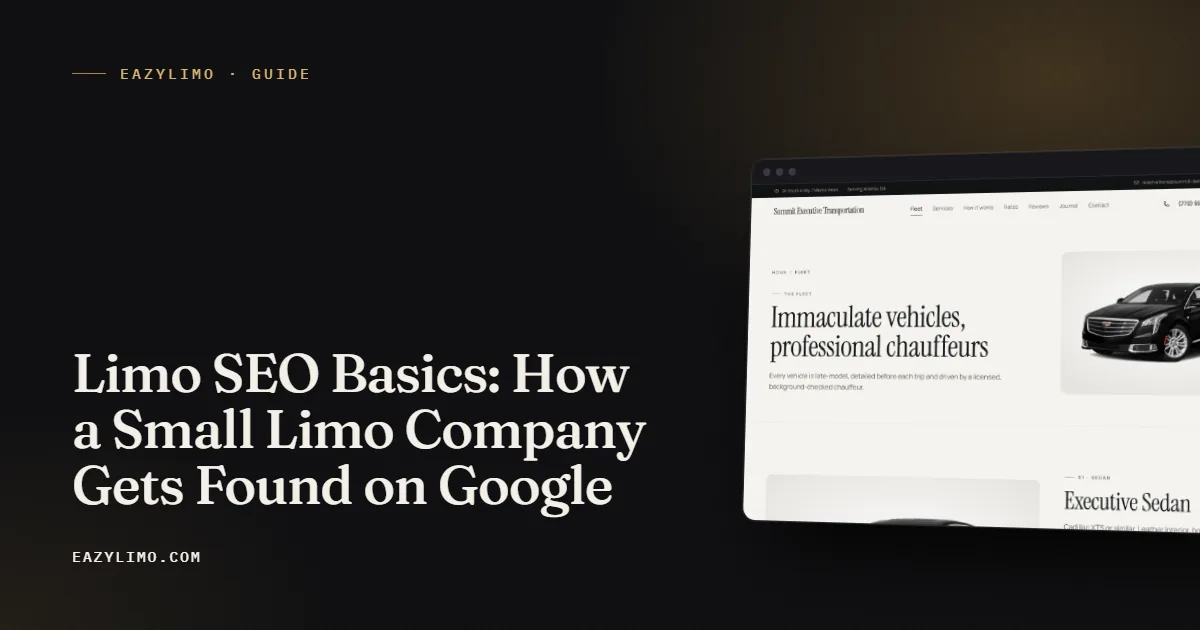
Search engine optimization sounds technical, but for a small limo company it comes down to a few practical jobs: understand what customers search for, build a page that answers each search well, make the site fast on a phone and give Google enough trust signals to show you. You do not need to become an SEO expert to get the basics right.
This guide explains the essentials in plain English, with examples you can apply to your own site this week.
Start with search intent
Search intent is what the person actually wants when they type a search. Limo customers are usually close to booking, and their searches tend to combine a service with a place. Matching your pages to those combinations is the foundation of limo SEO.
| Example search | What the person wants | Best page to answer it |
|---|---|---|
| limo service [city] | A local operator they can book | Home page or city page |
| [airport code] car service | A reliable airport transfer, often with a price | Airport page |
| wedding limo [city] | A vehicle for a wedding date, photos, packages | Wedding service page |
| hourly chauffeur [city] | Hourly rates and minimum hours | Hourly service page or rates page |
| how early to book a prom limo | Advice before they are ready to book | Blog post linking to prom service page |
Write down the ten searches you think your best customers use. Include your main city, nearby towns, the airports you serve and the services you are best at. That list becomes your page plan.
Build pages that match those searches
One general page that says "we do airports, weddings and corporate travel across the region" rarely ranks well for any of those searches. Separate pages give each search a clear answer.
Service pages
Create a page for each main service: airport transfers, hourly chauffeur service, weddings, corporate travel, proms and special events. Each page should explain what is included, which vehicles suit it, how pricing works, and how to book. Add real photos and a few questions customers actually ask.
Airport pages
Airport pages often bring some of the most ready-to-book visitors. For each airport you serve, include the terminals, where you meet passengers, how you handle flight delays, typical travel times to nearby areas and a booking form. Details specific to that airport make the page useful and different from every other page on your site.
City and area pages
City pages help when you serve several towns. A good city page mentions the neighborhoods, venues, hotels and routes you actually drive, the nearest airports and the services people there book most.
The home page should still carry your strongest message: who you are, the main area you serve and a booking form near the top. Our guide to limo website design goes deeper into page layout.
Avoid thin, duplicated city pages
A common mistake is creating fifty city pages that are identical except for the town name. These pages add little value for readers, and search engines generally treat large sets of near-duplicate pages as low quality. They can drag down how your whole site is seen.
Signs a city page is too thin:
- You could swap the city name for another and nothing else would need to change.
- It has no local details such as venues, routes, airports or travel times.
- It is only a few sentences long with a generic stock photo.
- You would not be comfortable sending a customer from that city to read it.
Start with the handful of areas where most of your trips happen. Write each page properly. Add more only when you can give each one real local substance. Fewer strong pages beat many weak ones.
Write clear titles and meta descriptions
The title tag is the blue headline in search results, and the meta description is often the short text beneath it. Every page needs its own unique title and description.
Title tips
- Put the main search phrase first, such as the service and city.
- Keep it short enough to show fully in results, usually around 60 characters.
- Add your business name at the end if it fits.
Description tips
- Summarize what the page offers and why someone should click.
- Mention a concrete detail, such as flight tracking or flat airport rates, if true.
- Keep it to roughly one or two sentences.
Illustrative examples for a fictional operator:
- Title: Airport Car Service to [Airport Name] | [Business Name]
- Description: Private chauffeur pickups and drop-offs at [Airport Name] with flight monitoring and meet and greet. Get an instant quote and book online.
Local schema in plain terms
Schema is a small block of code, usually in a format called JSON-LD, that describes your business in a way search engines can read reliably. It sits in the page code and visitors do not see it.
For a limo company, local business schema usually includes your business name, website, phone number, logo, service area, opening hours and links to your social profiles. Service and FAQ content can also be described with structured data.
Keep three points in mind:
- The information in your schema must match what is visible on the page and on your Google Business Profile.
- Schema helps search engines understand your site. It does not replace useful content or guarantee special results.
- Test your pages with Google's official rich results testing tool after changes, and check current guidance on what structured data Google supports.
Reviews and your Google Business Profile
For local searches, your Google Business Profile and your reviews work alongside your website. A steady flow of genuine reviews helps build trust with both customers and search engines. Review content that mentions specific services, such as airport pickups or weddings, also gives useful context.
Make reviews easy to leave with a short review link you can text after a trip and a QR card inside the vehicle. Show a selection of reviews on your website too. For the full setup, see the Google Business Profile guide for limo companies.
Speed and mobile experience
Most people looking for a limo search on their phone, often while traveling or planning an event. If your site is slow or the booking form is hard to use on a small screen, they go back to the search results and pick someone else.
Practical checks:
- Load your home page on your phone over mobile data. It should feel quick.
- Compress vehicle photos before uploading. Large images are the most common cause of slow pages.
- Make sure the phone number is tappable and the booking form fits the screen.
- Avoid pop-ups that cover the page on mobile.
- Remove plugins or scripts you no longer use.
This is where EazyLimo sites are designed to help: unique titles and descriptions, structured data, a sitemap, fast pages, and service, airport and city pages come built in. The features page lists what is included.
Blog topics and links from local partners
Blog topics that suit a limo company
A blog is useful when it answers questions your customers already ask. Some ideas:
- How airport pickups work at [Airport Name], step by step.
- How early to book a limo for prom or homecoming in [City].
- Wedding transportation timeline: when the car should arrive and leave.
- Best routes and timing for a night out in [Neighborhood].
- What to expect from a corporate car service account.
Each post should link to the matching service or airport page, so readers can book when they are ready.
Links from local partners
Links from relevant local websites help show that your business is real and trusted in your area. Good sources are relationships you already have or can build:
- Wedding venues and planners who list recommended vendors.
- Hotels and event spaces with transportation pages.
- Local business associations and chambers of commerce.
- Sponsorships of local events or school activities.
Avoid buying links or joining link schemes. They carry risk and rarely help a local business.
Measure with Google Search Console
Google Search Console is a free tool from Google that shows how your site appears in search. Add and verify your website, then submit your sitemap.
What to check each month:
- Queries: which searches show your pages and which get clicks.
- Pages: which pages bring visitors and which get none.
- Click-through rate: pages with many impressions but few clicks may need a better title or description.
- Indexing issues: pages Google could not index and why.
- Mobile and page experience reports: problems that affect phone users.
Compare these numbers with actual bookings. Search traffic that does not turn into trips points to a problem on the page, such as unclear pricing or a hard-to-find booking form. Our article on how to get more limo bookings covers that side.
Good limo SEO is mostly steady, honest work: useful pages for the searches that matter, a fast mobile site and real reviews. If you would rather start with a site that already has the structure in place, EazyLimo builds it for you. Pay once and own it (founding price $499 for the first 25 operators, then $999), or $79 a month.