Booking software
Limo booking software for small companies: what you actually need
A practical guide for 1-2 car limo operators: the booking features that matter, the enterprise extras you can skip, subscription vs one-time costs, and the questions to ask before you pay.
EazyLimo Team 8 min read
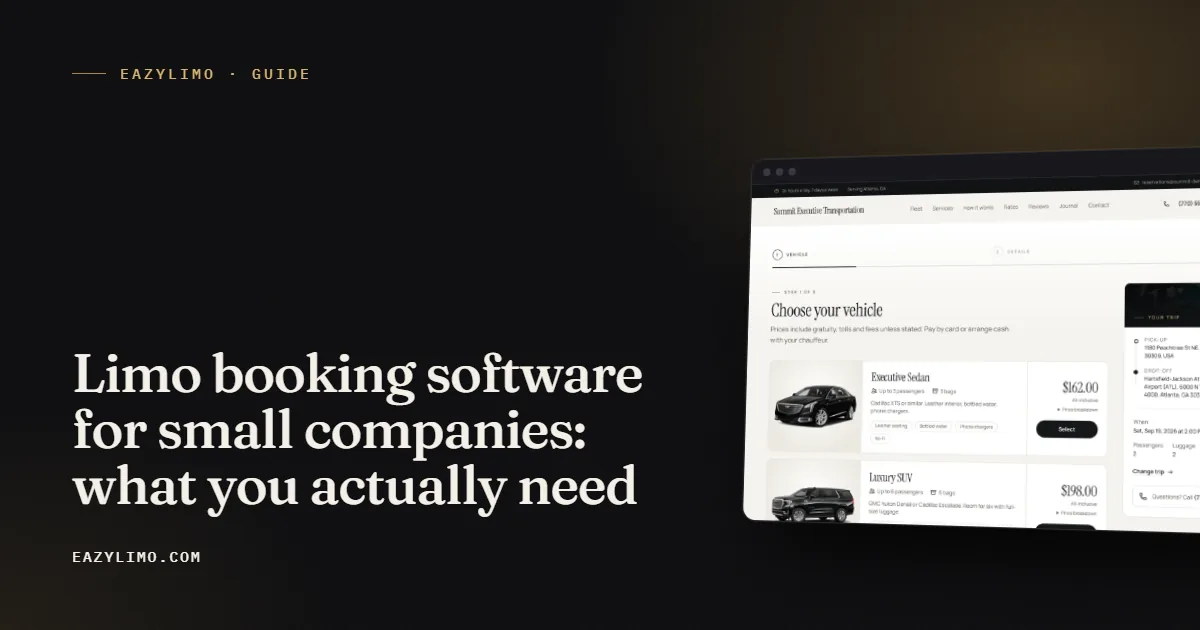
If you run one or two cars, most limo software was not built with you in mind. It was built for fleets with dispatchers, affiliate partners and an office full of staff. You end up paying every month for screens you never open, while the things you actually need, a booking form on your own website and a clear price for the customer, take extra setup or a paid add-on.
This guide breaks down what a small operator really needs, what you can safely skip for now, how the two main pricing models compare over three years, and the questions that expose a bad fit before you sign anything.
What a 1-2 car operator actually needs software to do
In a small limo company you are the owner, the chauffeur, the dispatcher and the bookkeeper. Most of your admin happens on a phone, in a parking lot, between trips. Good software shrinks that admin. It should handle the work that otherwise interrupts your day:
- Answering the same question over and over: how much is it from the airport to my hotel?
- Collecting the flight number, pickup address, passenger count and luggage details without a back-and-forth text thread.
- Taking payment or recording that the passenger will pay the chauffeur.
- Sending a confirmation so the customer stops worrying and you stop getting "are we still on?" calls.
- Keeping every job on a calendar so nothing gets double booked.
- Invoicing the corporate client who books a few rides a month and pays at month end.
Notice what is not on that list. You do not need a dispatcher console built for moving forty jobs between twenty drivers. Your priorities are different from a large operation, and the software you choose should reflect that.
Must-have features for a small limo company
A booking form customers can finish without calling you
The form is the most important part of the whole system. It should sit on your own website, work well on a phone, and cover the ride types you actually sell: point to point, hourly, airport transfers with flight details, round trips, and a few stops along the way. Address autocomplete and automatic distance calculation matter more than they sound, because a customer who has to type a full address and guess the mileage often gives up.
Pricing rules that match how you really quote
Many operators quote from memory or a note on their phone. Software should let you turn that into rules so the customer sees a real price instantly. Look for:
- A flat price for the first few miles, then mileage bands or a per-mile rate.
- A minimum fare so short trips still pay.
- Hourly pricing with a minimum number of hours.
- Flat routes for your common runs, such as the airport to downtown.
- Surcharges for nights, weekends, holidays and airport pickups.
- Extras like an additional stop, a child seat or meet and greet.
- Gratuity, tax and promo codes.
- A quote-only option for very long trips, so a 300-mile request comes to you instead of pricing itself wrong.
If you are still working out your numbers, our guide on how to price airport transfers walks through a full cost breakdown.
Payments that land in your own account
Ask where the money goes. The cleanest setup is card payments through your own Stripe account, PayPal if your customers like it, the option to pay the chauffeur in cash, and billing to a corporate account for regular business clients. Check whether the software vendor takes its own percentage on top of normal card processing, because that fee grows with every ride you sell.
Confirmations and a simple back office
Every booking should trigger a confirmation email to the passenger and a new-booking alert to you. Behind that you want a bookings list and calendar, a way to add phone bookings manually, a record of your vehicles, and simple driver assignment for the day you add a second chauffeur.
A website that brings the bookings in
Booking software with no traffic is an empty form. For a small operator, the website and the booking engine should work together: fast pages, a booking form near the top, and pages for the airports and towns you serve so people find you on Google. We cover the design side in detail in limo website design that turns visitors into bookings.
Enterprise features you can probably skip for now
These features are genuinely useful. They are just built for a different business than a one or two car operation. Before paying extra for them, ask yourself honestly how often you would use each one this year.
- Automatic dispatch. Valuable when many jobs need matching to many drivers. When you drive most trips yourself, you are the dispatcher.
- Live GPS map tracking. Helpful for a dispatch office watching a fleet. A short status text to the passenger often does the job for a small company.
- Native app-store apps. A branded app is nice, but most one-off customers will not download an app to book a single airport ride. A fast mobile website works for them.
- Affiliate network integrations. Useful for operators doing high volumes of network work. Smaller operators often share jobs directly with a few trusted partners instead.
- Accounting software sync. Handy at scale. At low volume, a monthly CSV export to your bookkeeper usually works.
If one of these is a real requirement today, choose a platform that includes it and do not compromise. If it is a nice idea for some day, do not pay for it every month until that day comes.
Subscription vs one-time purchase: the cost models compared
Limo software is sold in two main ways. With a subscription you pay monthly, often with a setup fee, and sometimes with per-trip overages, paid add-ons or a card processing percentage. With a one-time purchase you pay once, own what you bought, and may pay a smaller yearly amount for hosting or updates.
The only fair way to compare is to add everything up over the same period, using each vendor's current prices, your ride volume and the add-ons you would really use. This table shows where the costs come from in each model.
| Cost | Subscription | One-time purchase |
|---|---|---|
| Upfront | Sometimes a setup fee | The purchase price |
| Every month | The plan fee, for as long as you use it | Nothing |
| As you grow | Overages or a higher plan may apply | Usually unchanged |
| Payments | Normal processing, sometimes plus a platform percentage | Normal processing |
| Yearly | Included in the monthly fee | Optional hosting or updates |
| If you stop paying | Access to the software ends | Depends on the vendor; ask what you keep |
For reference, EazyLimo is $999 once and you own it (founding price $499 for the first 25 operators), with optional hosting at $199 a year including updates, or self-hosted with 12 months of updates and then optional updates at $99 a year. Over three years that is $1,596 hosted at the list price, or $999 to $1,197 self-hosted. If you would rather not pay upfront, the monthly plan is $79 a month with hosting and updates included and a 12-month minimum, though on that plan you rent the site rather than own it.
Two things are worth saying plainly. First, dispatch-focused tools help you manage bookings you already have, but they do not give you your own SEO website to attract customers. Second, if you run a larger fleet with dispatch staff and affiliate work, a full enterprise platform may well be worth its monthly price. For a longer side-by-side, see our overview of Limo Anywhere alternatives.
A buying checklist for small operators
Print this or keep it on your phone while you look at demos. If a product cannot tick most of these boxes, keep looking.
- Customers can get a price and book on a phone in a couple of minutes.
- The booking form lives on your own domain, not only on a vendor page.
- Airport bookings capture the airline and flight number.
- Pricing supports mileage bands, minimum fares, hourly minimums and flat routes.
- Surcharges and extras can be added without a support ticket.
- Payments go to your own Stripe or PayPal account, with cash and corporate billing as options.
- The passenger gets a confirmation email and you get an instant alert.
- You can add phone bookings manually and see everything on a calendar.
- Your website pages have unique titles and descriptions and load quickly.
- You can export your bookings to CSV at any time.
- You understand the total cost over three years, including every fee.
- You know what happens to your site and data if you stop paying.
Questions to ask any vendor before you pay
Sales pages all look good. These questions get you past them.
- What is my total cost for three years at my ride volume? Ask them to include setup, overages, add-ons and any percentage fees.
- Do you take a cut of each payment? Separate the vendor fee from normal card processing.
- Who owns the website and the customer data? Get a clear answer in writing.
- If I cancel, what do I keep? Some plans switch everything off; others let you keep a copy.
- Does the price include a public website, or only a booking widget? A widget still needs a site to live on.
- Who sets it up? Find out whether you configure everything yourself or whether it is done for you, and how long that usually takes.
- Can I change my own prices and surcharges? You should not need to wait on support to raise a holiday rate.
- What happens when I add a second driver or vehicle? Check whether that moves you to a higher plan.
A simple way to make the decision
Do not overthink it. Work through these five steps in one evening.
- Count your rides per month over the last few months and estimate the next year.
- Write down how you quote today: your airport prices, hourly rate, minimums and extras.
- Decide whether you already have a website that brings in bookings. If not, the website matters as much as the software.
- Calculate the three-year cost of your top two or three options using your real volume.
- Book a test trip on each demo from your phone, as a passenger would.
The right choice is usually obvious after step five. The product that is easiest for your customers and fits your pricing, at a total cost you are comfortable with, is the one to pick.
Where EazyLimo fits
EazyLimo was built for exactly this kind of operator: owner-operators with one or two vehicles, often without a website yet. You get a custom website with the booking engine built in, set up for you from your logo, vehicle photos and rates. Pay once and own it (founding price $499 for the first 25 operators, then $999), or pay $79 a month. Payments go to your own Stripe or PayPal accounts. If you want to see how it feels from the passenger side, open the live demo on your phone and book a test ride.